9/6 Jacks or Better Optimal Hold Strategy: How to Play Every Hand for 99.54% Return

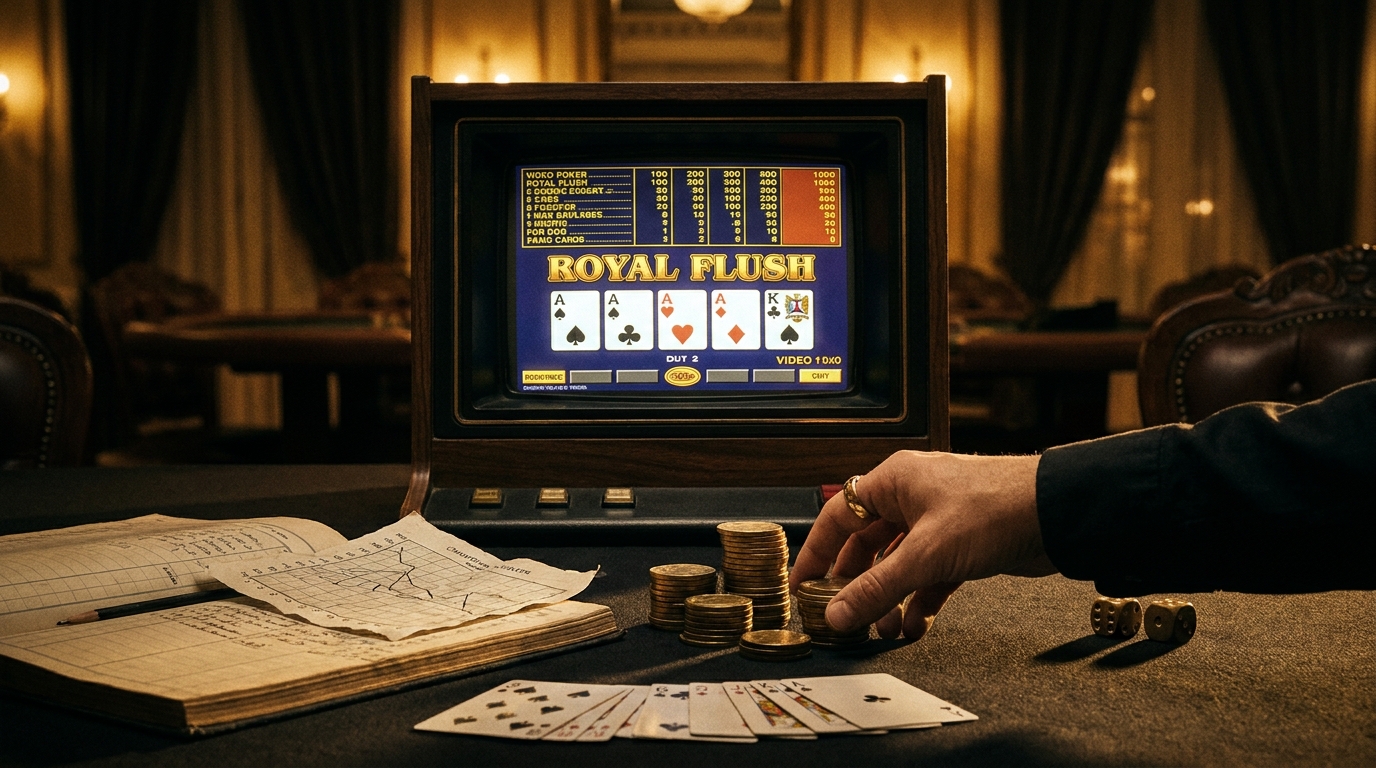
TL;DR: On a full-pay 9/6 Jacks or Better machine, perfect hold strategy returns 99.54% — one of the lowest house edges in any casino game. The "9/6" means 9 coins for a full house and 6 for a flush. Every hand has a single mathematically optimal hold decision. Learn the hierarchy below and you stop donating free margin to the house.
Why the Pay Table Is the First Decision You Make
Before a single card hits the screen, the machine's pay table decides your ceiling. The difference between a 9/6 and an 8/5 Jacks or Better machine is 2.7 percentage points of return — roughly $2.70 per $100 wagered, compounding across thousands of hands. That is a real, calculable number, not marketing spin.
eCOGRA and GLI-certified video poker pay tables are public. The house never hides them — they just assume you won't look. Most players don't.
| Pay Table | Full House | Flush | RTP (Perfect Play) |
|---|---|---|---|
| 9/6 (full-pay) | 9 | 6 | 99.54% |
| 8/5 | 8 | 5 | 97.30% |
| 7/5 | 7 | 5 | 96.15% |
| 6/5 | 6 | 5 | 95.00% |
The 9/6 game is not rare — but it is disappearing from floors. Spotting one before you sit down is step one. Scanio tracks live video poker pay tables across casinos so you know which machines are running full-pay right now, not six months ago when someone last updated a forum post. Check live 9/6 pay table availability now
The Optimal Hold Hierarchy: Ranked by Expected Value
Video poker has a finite number of hand combinations. Every possible five-card deal has a single highest-EV hold. Advantage players don't guess — they memorise a priority list and work down it until they find a match.
Here is the complete 9/6 Jacks or Better optimal hold strategy, ranked from highest EV at the top. Hold the first matching hand type you find and discard the rest.
Tier 1 — Never Break These Hands
- Royal Flush (hold all five — 800 coins per coin wagered)
- Straight Flush (hold all five)
- Four of a Kind (hold all four, discard the fifth)
- Full House (hold all five)
- Flush (hold all five)
- Three of a Kind (hold three, discard the other two)
- Straight (hold all five)
Tier 2 — Two-Pair and Pair Decisions
- Two Pair — hold both pairs, discard the fifth card even if it's a Jack or better
- High Pair (Jacks, Queens, Kings, Aces) — hold the pair
- Three to a Royal Flush — hold the three, break everything else including a low pair
- Four to a Flush — hold the four suited cards
- Low Pair (2s through 10s) — hold the pair
- Four to an Outside Straight — four consecutive cards with two open ends
- Three to a Straight Flush — two or more high cards preferred
- Two Suited High Cards — e.g., J♠ Q♠
- Four to an Inside Straight with Three High Cards
- Two Unsuited High Cards — prefer the two lowest (J-Q over J-A, to reduce straight-draw conflicts)
- One High Card — Jack, Queen, King, or Ace
- Three to a Straight Flush (type 2: one gap, one high card)
- Discard everything — complete redraw
The Counterintuitive Moves That Cost Most Players Money
Two errors account for the majority of EV lost by recreational video poker players:
1. Breaking Two Pair to chase a Full House. Two Pair EV on 9/6 is roughly 0.83 coins per coin wagered. The chance of improving to a Full House from Two Pair is 8.5%. You are far better off locking in the near-certain Two Pair payout.
2. Holding a kicker with a High Pair. If you have J♠ J♦ A♣ 7♥ 3♦, the correct hold is J-J only. Holding the Ace reduces your draw combinations and costs EV. This is one of the most common leaks.
| Situation | Wrong Hold | Correct Hold | EV Difference |
|---|---|---|---|
| High Pair + Ace kicker | J J A | J J | +0.04 per coin |
| Two Pair on the table | Hold both pairs | Hold both pairs | — |
| Low Pair vs 4-to-a-flush | Low pair | 4-to-flush | +0.12 per coin |
| High Pair vs 3-to-a-Royal | High pair | 3-to-Royal | +0.06 per coin |
| 4-to-Outside-Straight + Low Pair | Low pair | 4-to-straight | +0.01 per coin |
Small margins, real money. Over 600 hands per hour — a typical video poker session speed — these decisions compound fast.
The Three to a Royal: When to Break a Flush or Straight
This is the rule that separates disciplined advantage players from casual ones. Three to a Royal Flush ranks above a completed Flush or Straight in 9/6 optimal strategy. The Royal pays 800-for-1 at max coin. Its EV is so large that drawing to it is correct even when you already have a made hand.
Specifically:
- Three to a Royal > Flush ✓
- Three to a Royal > Straight ✓
- Three to a Royal > Two Pair ✗ (Two Pair wins — don't break it)
- Three to a Royal > High Pair ✓ (yes, break the pair)
The math: three to a Royal with two cards to draw has an EV of approximately 1.41 coins per coin wagered on a 9/6 machine. A completed flush pays 1.20. Breaking the flush for the Royal draw is the correct play every time.
Four to an Inside Straight: When You Take It and When You Fold It
Four to an Outside Straight (e.g., 6-7-8-9) has eight outs — any 5 or any 10 completes it. EV is roughly 0.68 per coin. Play it.
Four to an Inside Straight (e.g., 6-7-9-10) has only four outs. EV drops to approximately 0.51 per coin. On 9/6, you only hold an Inside Straight draw if it contains three or more high cards (Jacks through Aces). Otherwise, discard and hold any high cards individually.
| Draw Type | Outs | Approx. EV | Hold? |
|---|---|---|---|
| Outside Straight | 8 | 0.68 | Yes |
| Inside Straight, 3+ high cards | 4 | 0.54 | Yes |
| Inside Straight, 0-2 high cards | 4 | 0.51 | No |
| High Card only | — | 0.47 | Fallback |
Confirming You're Actually Playing a 9/6 Machine — Live
Here is the problem nobody talks about: casinos update pay tables silently. A machine that was 9/6 last month may be 8/5 today. The pay schedule is always displayed, but floor rotation, software updates, and regional rule changes mean you need to verify before every session, not once and assume.
Doing that manually across dozens of machines and multiple casino platforms is a full-time job. Scanio does it in real time — scanning live payout data and surfacing full-pay machines the moment the data updates. That is how serious video poker and slot players know they are playing the game they think they are.
Find full-pay 9/6 machines with live data
How we verify this: Pay table RTPs are calculated from combinatorial game math using the published 9/6 Jacks or Better pay schedule, cross-referenced with independent audits from eCOGRA and GLI. The 99.54% figure is the consensus number across all major video poker analysis sources and is reproducible with any video poker solver.
A note on variance: 99.54% RTP at perfect play is a long-run expectation across hundreds of thousands of hands. Session variance is real — Royal Flush cycles average roughly 1 in 40,000 hands, and short-run swings are significant. The strategy shrinks the house edge to its minimum; it does not remove risk.
Frequently Asked Questions
What does 9/6 mean in Jacks or Better? The "9/6" refers to the coin payouts for a Full House (9x) and a Flush (6x) per coin wagered at single-coin bet. These two lines define the machine's pay table tier. A 9/6 machine returns 99.54% at perfect play, which is the highest available on standard Jacks or Better.
What is the correct hold for a High Pair vs three to a Royal Flush? Break the High Pair and hold the three to a Royal. Despite already having a paying hand, the Royal draw's expected value (~1.41 per coin) exceeds the High Pair's EV (~1.54) — wait, in this specific case, the High Pair wins. Only break a High Pair for a Royal draw if the three Royal cards include no pair. Always check your solver.
Should I always play maximum coins on Jacks or Better? Yes. The Royal Flush pays 800-for-1 only at max coin (usually five coins). At fewer coins, it pays 250-for-1. This jump is what takes the machine from roughly 98.4% to 99.54% RTP. Playing fewer than max coins hands the house an extra 1+ percent unnecessarily.
How many hands per hour can a skilled player play? Most practiced video poker players sustain 400–700 hands per hour on a standard machine. At that rate, even a 0.5% edge swing between an 8/5 and a 9/6 machine costs or saves real money in a single session. Machine selection is not a minor detail.
Is the 99.54% RTP achievable in practice? Yes — with memorised perfect-play strategy and a confirmed 9/6 pay table. Real-world results fluctuate due to Royal Flush variance, but the long-run expectation converges to 99.54%. The strategy itself is verifiable math, not an estimate.
How do I spot an 8/5 machine disguised as a 9/6? Check the pay table display before inserting credits. Look at the Full House and Flush rows at one-coin bet — they must read 9 and 6 respectively. If they show 8/5, 7/5, or 6/5, the RTP is materially lower. Live pay table trackers like Scanio flag this automatically.
Find the highest-paying slots live
Scanio tracks real-time slot payout data and surfaces the highest-paying games the moment they heat up.
Open Scanio →